You’re not imagining it: the car is getting harder to live with
It usually starts as small stuff you work around: a longer crank in the morning, a warning light that comes and goes, a vibration you learn to ignore. Then the “quick fix” turns into a dropped day, a tow, or a scramble for rides when the car won’t make it to work or school.
That slide isn’t in your head. As parts wear, problems bunch up, and each visit to the shop carries more uncertainty because you can’t see the next failure yet. Even when the bill is manageable, the downtime and the planning effort aren’t.
The hard part is deciding whether you’re paying for maintenance—or paying to keep taking the risk. That starts with what this year of repairs actually cost you.
What did this year of repairs really cost you?
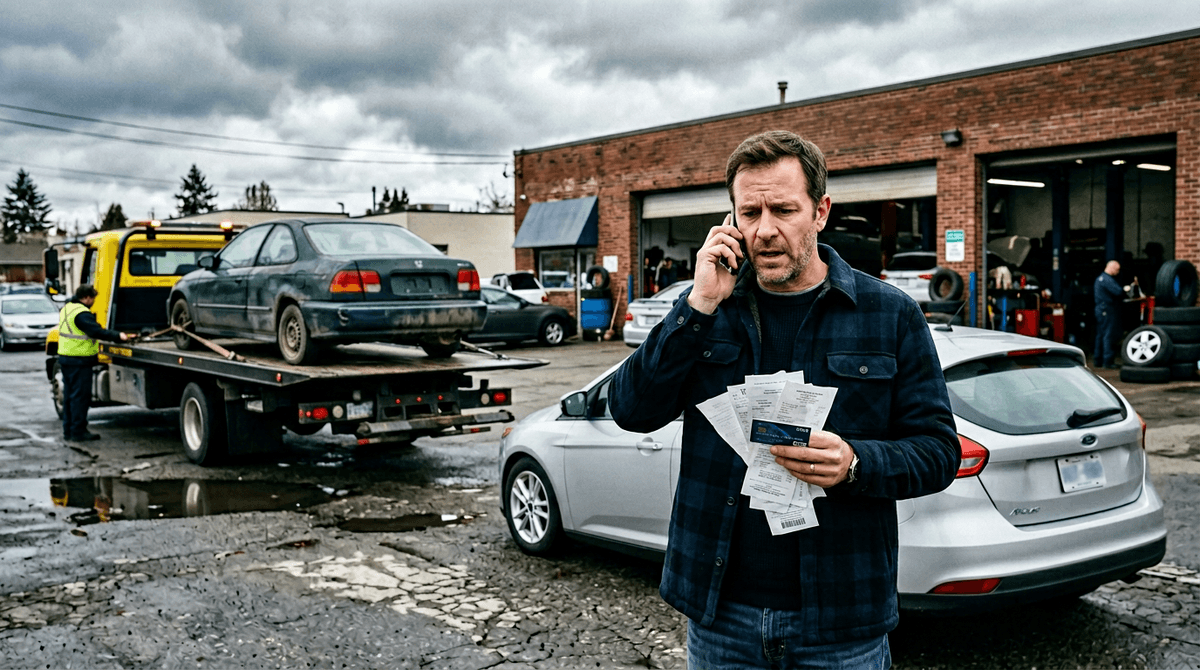
That “what it cost” question usually gets answered with whatever you remember from the biggest invoice. Don’t do it that way. Pull the last 12 months of receipts and list every spend tied to keeping the car on the road: shop bills, tires, battery, fluids, towing, rental cars, and the rides you paid for when it was down. If you used a credit card and paid interest, include that too.
Then add the costs that don’t show up on receipts. Count hours lost to dropping it off, waiting, calling around, and rearranging work or childcare. Put a dollar value on that time using your hourly pay or a realistic number you’d pay someone to cover you. It won’t be perfect, but it will be honest.
This doesn’t predict the next failure. It only tells you what “keeping it” has already demanded, which sets a baseline for what the next six months is likely to feel like.
When reliability risk becomes a daily-life problem
That baseline is where reliability stops being an abstract “risk” and starts showing up in your calendar. You begin leaving early “just in case,” keeping a jump pack in the trunk, or avoiding certain trips because you can’t afford a surprise no-start. If you’re arranging backups more than once a month—rides, rentals, borrowing a car—that’s no longer normal ownership hassle. It’s a daily-life problem.
Watch for the moment the car forces you to build a second plan. If a breakdown would cost you a shift, a late pickup, or a missed appointment you can’t reschedule, the downside is bigger than the repair bill. The same $600 fix feels different when it comes with two days of downtime and a week of stress.
A practical constraint: you can’t “budget” your way around random failures. Time off, shop schedules, and parts delays don’t care what you planned. That’s why the next question isn’t just what it cost—it’s what the next six months is supposed to look like if you keep it.
If you keep it, what’s your next 6 months supposed to look like?
That question gets real the first time you try to plan a normal month and realize the car is now part of the schedule. If you keep it, sketch the next six months like you’re managing a project: upcoming trips, work deadlines, school dates, and any “can’t miss” days where a breakdown would cause real damage. Then ask what support you’d need if the car is unavailable for 48–72 hours twice. If you don’t have a second vehicle, that usually means lining up a ride list, checking rental rules, and setting aside cash that can move fast.
Now add the predictable items you’ve been postponing—tires near the wear bars, brakes that are “soon,” a leaking valve cover, a battery past its best years—and put rough timing on them. If two or three of those land in the same season, you’re not “maintaining,” you’re running a rolling restart.
Shops get booked, parts get backordered, and your life won’t pause. If you can’t describe a workable six-month plan in one page, you’re already operating past your comfort line.
The replacement triggers that matter more than miles
If you’re already operating past your comfort line, mileage stops being the deciding number. Two cars can both have 140,000 miles, and one fits your life while the other keeps forcing last-minute cancellations. The triggers that matter are the ones that change how you schedule your week.
Start with “missed-day impact.” If a no-start would cost you a shift, a client, or a late pickup you can’t fix with a quick call, that’s a replacement trigger. Next is “repeat failure mode”: the same issue returns (overheating, charging problems, misfires, brake pulsation) even after repairs, because you’re no longer buying a fix—you’re buying another attempt. Add “parts and shop reality.” If your trusted shop can’t get you in for 7–10 days, or parts delays regularly stretch a 1-day job into a 3-day outage, the car becomes unreliable even when it’s technically repairable.
One hard constraint: you can’t control when the next failure lands, only how exposed you are when it does. Once you name your triggers, you can run the money comparison without fooling yourself.
Running the money comparison without tricking yourself

Once you name your triggers, the money math gets clearer—but it’s still easy to “win” the comparison by leaving out the ugly parts. Start with two monthly numbers: what keeping the car has cost you on average (from the last 12 months), and what replacing it would cost all-in each month. For the replacement side, use a real out-the-door price, taxes/fees, insurance change, and a realistic interest rate if you’d finance. If you’d pay cash, treat that cash like it has a cost too: what you’d lose by not having it for emergencies.
Then add the keep-car reserve. Set a monthly “failure fund” based on your recent average plus a buffer, because repairs don’t arrive evenly. If your car averages $250/month but it shows up as two $900 hits, you need liquidity, not just a spreadsheet.
The comparison can’t price the worst-timing breakdown. So include a simple rule—if a single repair would exceed your down-payment or blow up your schedule trigger, you stop feeding it and switch plans.
Choose a plan: buy now, wait with a line in the sand, or save to a date
That “simple rule” is what turns stress into a plan. If your triggers are already active and you can’t cover a surprise outage without missing work or care duties, buying now is the cleanest move—even if the payment stings—because it stops the calendar damage.
If you’re not there yet, wait with a line in the sand: pick one clear threshold (for example, “any single repair over $1,200,” or “more than 2 days down in a month,” or “the same issue comes back”) and decide in advance that crossing it means you shop immediately. The downside is you may have to buy under pressure.
If cash is the blocker, save to a date. Set a target month, auto-transfer weekly, and treat your failure fund as untouchable. Then you’re choosing the timing instead of letting the car choose it.