When your paycheck rises but cash shrinks
The raise hits, the paycheck number looks better, and then the account balance still drifts downward. It’s rarely one big leak. More often it’s a quiet stack: the grocery total creeping up by $20–$40 a trip, the car insurance renewal landing higher than last term, a couple of “small” subscriptions that all raised prices, and a few delivery meals on the weeks that felt busiest. Meanwhile, savings and investing may have auto-inched upward after the raise, so the extra income gets spoken for before anyone notices. The frustrating part is timing: these increases don’t arrive on payday, they show up mid‑month when the margin is already thin.
Before cutting anything, treat this as a cash-flow problem, not a discipline problem. The goal is to find which categories are expanding faster than your income, without triggering the kind of cuts that create a bounce-back spend later.
Stop guessing: trace one month of outflows
So the next move isn’t to “be better” for a week. It’s to capture one ordinary month exactly as it happened, even if it’s messy. Pick the most recent full month with no unusual travel, then pull every outflow in one place: checking, credit cards, Venmo/Zelle, Apple/Google, and any “pay later” accounts. Give yourself a tight time box—45 minutes tonight, 45 minutes tomorrow—because the project tends to sprawl once you start hunting for missing charges.
Now lay the expenses on a calendar, not just a category list. The timing is where the squeeze shows up: mortgage/rent and childcare early, utilities mid‑month, insurance or quarterly bills dropping on random days, then a cluster of small food and convenience buys right after the busiest workweeks. Mark anything that’s (1) fixed and unavoidable, (2) fixed but negotiable, or (3) flexible. That third bucket is where comfort and cash live together, and it’s usually larger than it feels until the numbers are staring back.
If a charge can’t be identified, don’t ignore it—flag it. “Unknown $28.73” is how repeat spending hides, and it’s often the easiest $100–$200/month to clean up once it has a name.
The first cuts that usually backfire

With the month mapped out, the temptation is to grab the obvious “discipline” levers: cancel every fun thing, swear off restaurants, slash the grocery line by force. Those are the cuts that feel decisive on day one and quietly unravel by day ten. The calendar you just built usually shows why—your highest-spend days cluster around fatigue, deadlines, kid logistics, or long commutes. When the cut ignores that timing, you don’t spend less; you just change the form of the spending, often into something pricier.
The classic backfires: (1) an aggressive grocery clampdown that leads to midweek takeout when the pantry plan collapses, (2) dropping a gym or class you actually use and replacing it with “retail therapy” or impulse delivery on stressed evenings, (3) cutting every subscription at once and then renting movies, buying apps, or upgrading data because boredom is now friction, and (4) skipping small conveniences that protect your schedule—parking, occasional rideshares, a paid car wash—until one chaotic week triggers a $300 convenience spree.
If a cut reliably creates a “make it up later” feeling, it isn’t saving; it’s borrowing comfort at a high interest rate. Keep those on a hold list for now and look for swaps before strips.
Swap, don’t strip: find equal-comfort substitutes
Once you’ve seen which purchases cluster around stress and time pressure, the productive move is to protect the function they serve. The spend isn’t “food” or “entertainment” in the abstract; it’s dinner that arrives when nobody can cook, or a small hit of relief after a long day. Stripping those out creates a comfort deficit that usually gets repaid with interest. Swapping keeps the relief but changes the unit cost, and it works best when you pick one swap per high-risk window, not ten new rules at once.
Start with the categories that have both frequency and wiggle room. If delivery is the pressure valve, cap it by replacing two orders a week with one “backup dinner” that’s genuinely easy: a rotisserie chicken night, freezer staples, or a local takeout place you pick up on the way home. If subscriptions keep getting added because the house gets bored, rotate them monthly instead of stacking them. If commuting costs are creeping, swap two days of parking or tolls for a planned transit day or a carpool—only if the timing works. The constraint is realism: if the substitute adds friction on your hardest days, it won’t last.
Run two-week experiments before committing
After a few smart swaps, the pressure shifts from “what should we cut?” to “will this actually hold when the week gets ugly?” That’s where two-week experiments earn their keep. Fourteen days is long enough to hit a weekend, a busy stretch at work, and at least one unexpected schedule change, but short enough that a failed idea doesn’t feel like a moral defeat. Pick one change to test, put a dollar target on it (save $60 over two weeks on food, $40 on transport), and decide the rule in advance: what counts as success, and what would make you stop.
Then run it like a small study. Keep the rest of spending normal so the result isn’t muddy. Track only three numbers: how much you spent in that category, how many “pain moments” showed up (nights the plan felt impossible), and whether the experiment caused rebound spending somewhere else. If a grocery plan saves money but produces two panic takeout orders, it’s not a win yet—it’s a redesign.
At day 14, don’t negotiate with fatigue. Either (1) keep it as-is, (2) keep it with one adjustment that removes the worst friction, or (3) drop it and try a different swap. The commitment comes after the data, not before.
Protect your wins from rebound spending
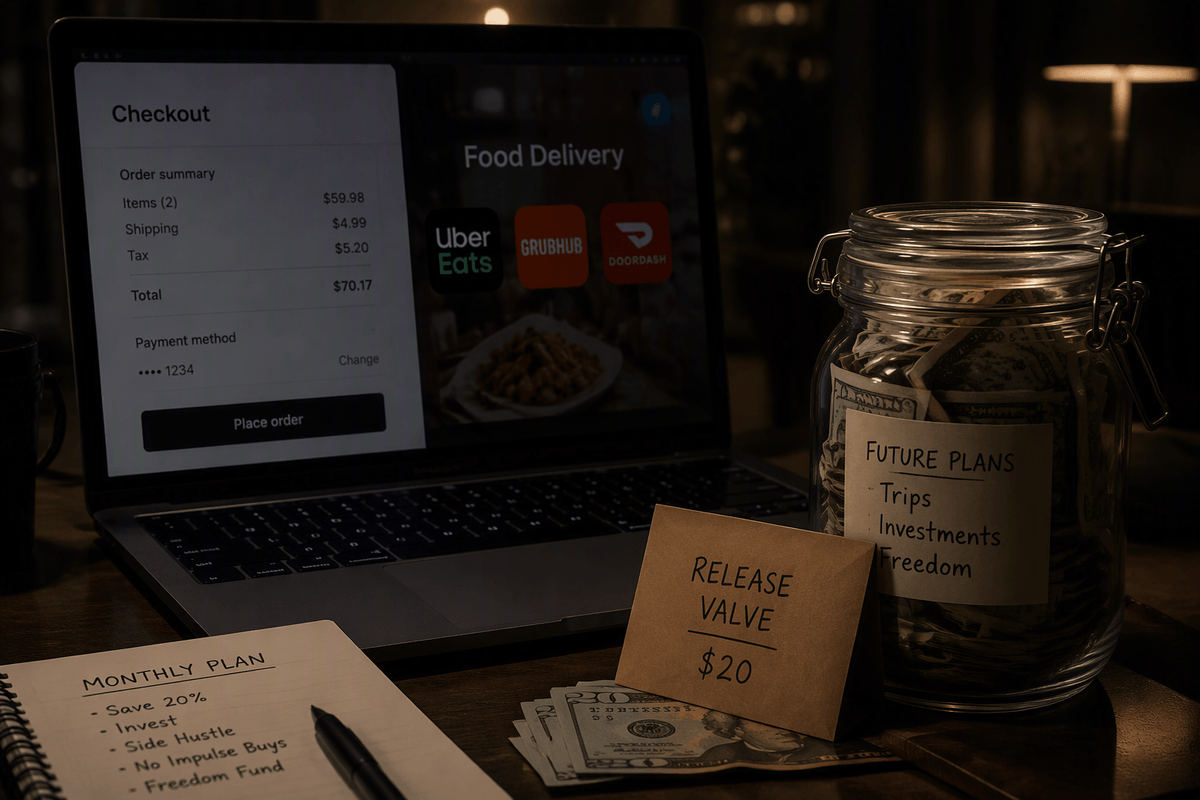
The first week a swap works, the money starts to show up—and that’s when it gets slippery. The account balance looks “fine,” a stressful Tuesday hits, and a small exception slides in: delivery again, a couple of one‑click buys, an upgraded add‑on at checkout. It doesn’t feel like blowing the plan; it feels like using the breathing room you earned. But if the extra cash isn’t given a job, it gets assigned by whatever is loudest that day.
So treat savings from the experiment like a bill with a due date. The day after payday, move the expected two‑week savings into a separate bucket (or send it straight to debt principal, savings, or investing). Leave a defined “release valve” too—maybe $25–$50 a week for convenience—because a plan with zero slack usually creates a bigger snapback. The constraint is timing: automate the win early, and make the indulgence small enough that it can’t quietly become the new normal.
Lock in a simpler monthly baseline you’ll keep
By the time a couple of swaps have survived two weeks, the question stops being “can we do this?” and becomes “what do we want a normal month to look like?” This is the part people skip, and then the old month quietly reappears. Set a baseline using only what proved it could hold: the new grocery range, the delivery cap, the subscription rotation, the transport change. Write those as monthly numbers and make them the default, not the “good month” version. The constraint is boredom—without a default, decisions creep back in daily.
Then lock it with one small structural move: reset autopays to match the baseline and schedule one monthly “keep/cut” check that takes 15 minutes. If costs rise again, you’re not starting over; you’re adjusting a simpler system that already fits your real week.